

A period home in Salisbury isn’t just a building; it’s a piece of Wiltshire’s history that requires a custodian’s touch rather than a standard contractor’s hammer. Embarking on a period property renovation Salisbury project often brings a unique set of challenges, from managing rising damp in centuries-old brickwork to meeting the strict requirements of local conservation areas. You likely want to modernise your living space without erasing the architectural soul that made you fall in love with the property in the first place.
It’s natural to feel protective of your home’s heritage whilst worrying about the practicalities of 21st-century living. This guide shows you how to sympathetically restore and extend your historic Salisbury home to achieve a modernised space that maintains its unique character and structural integrity. We’ll explore the updated 2026 planning landscape, essential techniques for traditional brickwork and carpentry, and how to navigate conservation restrictions to ensure your property remains a valuable, beautiful asset for generations to come.
Key Takeaways
- Understand the core principles of a period property renovation Salisbury to ensure your home remains structurally sound whilst retaining its historical soul.
- Discover how traditional bricklaying and carpentry techniques prevent common issues like damp and preserve the authentic facade of historic buildings.
- Learn the strategic approach to designing extensions that complement Salisbury’s unique architectural styles, from Georgian townhouses to Victorian terraces.
- Navigate the complexities of local planning permissions and conservation area regulations with confidence to avoid costly delays.
- Identify the benefits of partnering with a local authority who understands the specific nuances of Salisbury’s historic housing stock.
Understanding Period Property Renovation in Salisbury
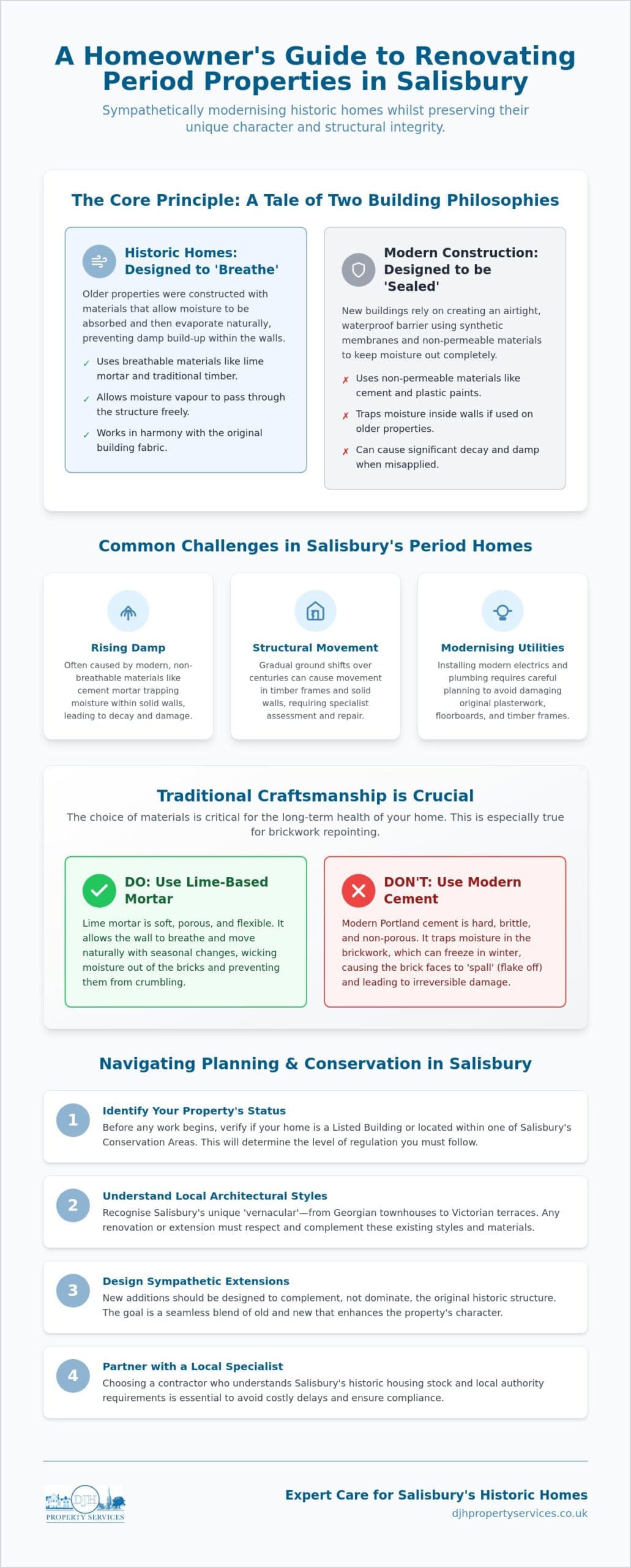
A period property renovation Salisbury project requires a mindset that respects the building’s history as much as its future. This process involves restoring the structural integrity of a dwelling while meticulously preserving its aesthetic heritage. Period restoration is the balance between heritage preservation and modern comfort. Unlike modern construction, which relies on airtight seals and synthetic membranes, historic homes were designed to “breathe” through their materials. This fundamental difference means that a standard building approach often causes more harm than good.
Using the wrong materials, such as modern cement mortars or non-permeable paints, can trap moisture within the walls. This leads to significant structural decay and damp over time. A successful renovation involves selecting breathable materials like lime mortar and traditional timber that work in harmony with the original fabric. We’ve seen how the right choice of material ensures a building remains dry and stable for another century.
The Unique Character of Salisbury Architecture
Salisbury’s architectural landscape is a rich tapestry of history. You’ll find everything from the grand symmetry of Georgian townhouses near the Cathedral Close to the sturdy red brick and flintwork of Victorian terraces in the surrounding streets. This local “vernacular” describes the specific materials and styles that define our city. Understanding these nuances is vital because the city’s historic layout often dictates what’s possible. Narrower plots and shared party walls in older districts require a precise, methodical approach to any home alterations or extensions.
Common Challenges in Older Salisbury Homes
Many homeowners face the persistent issue of rising damp. This is often exacerbated by the misuse of modern cement in old walls that were never designed for it. Older properties were built with solid walls that require moisture to evaporate freely. Structural movement is another common concern, particularly in timber-framed or solid-wall buildings where the ground has shifted over decades. Before starting work, it’s essential to understand the legal status of your home. You should verify whether your home falls under specific protections by researching What is a Listed Building? to ensure compliance with national heritage laws.
Modernising electrical and plumbing systems also requires a delicate touch. You need to install 21st-century amenities without compromising original floorboards or decorative plasterwork. It’s about finding hidden routes for cabling and pipework that don’t weaken the timber frame or scar the masonry. These challenges aren’t roadblocks; they’re simply puzzles that require a seasoned professional’s experience to solve correctly.
Structural Integrity and Traditional Craftsmanship
The success of any period property renovation Salisbury relies on the hands that execute the work. While modern builds focus on speed, historic restorations demand a slower, more methodical approach rooted in traditional craftsmanship. Skilled tradespeople don’t just fix a house; they ensure its structural legacy continues for another hundred years. This level of expertise is particularly vital in Salisbury, where the city’s urban fabric is composed of delicate masonry and complex timber frames.
Protecting your historic investment requires a proactive strategy. Once the major structural work is complete, ongoing property maintenance Salisbury becomes the first line of defence against the elements. Small issues, like a slipped roof tile or a hairline crack in the mortar, can lead to significant decay if ignored in an older building. Regular care ensures that the structural integrity established during a renovation is never compromised.
Brickwork and Repointing in Historic Houses
Salisbury’s older facades often feature a distinct blend of red clay bricks and local flintwork. When these walls require repair, using modern Portland cement is a common but damaging mistake. Modern cement is too hard and non-porous; it forces moisture into the bricks themselves, causing them to flake and crumble over time. Instead, we utilise lime-based mortars that allow the building to breathe and flex naturally.
Matching the specific colour and texture of local Salisbury brickwork is an art form. It requires sourcing salvaged materials or specifying new bricks that age gracefully alongside the original masonry. For those managing protected homes, following the official guidance for owners is essential to ensure that repointing and structural bricklaying meet heritage standards. This careful attention to detail preserves the authentic character of your chimney stacks and exterior walls.
Carpentry and Timber Restoration
The internal soul of a Victorian or Edwardian home is often found in its woodwork. From the heavy floor joists that support the house to the intricate mouldings of a sash window, timber is the backbone of the property. Skilled carpentry is required to restore these elements sympathetically. We often find that floor levels in older Salisbury homes have shifted over decades. Bespoke carpentry allows us to correct these level issues without losing the original charm of the room.
Restoring original roof timbers or fitting hand-crafted period doors requires a deep understanding of historical joinery techniques. It’s about finding the right balance between modern structural requirements and period-accurate aesthetics. If you’re planning a project that requires this level of precision, our team of skilled carpenters and bricklayers can help you navigate the complexities of your renovation.
Sympathetic Home Extensions for Historic Houses
Adding a home extension in Salisbury is one of the most effective ways to increase property value while creating the functional space modern families require. However, the challenge lies in designing an addition that complements the original architecture rather than competing with it for attention. A successful period property renovation Salisbury project ensures that new structures feel like a natural evolution of the home. This requires a deep understanding of scale, proportion, and the way light interacts with traditional solid-wall buildings.
Choosing materials that age gracefully is essential. Rather than using modern, uniform bricks that will always look “new,” we often recommend reclaimed materials or specific local blends that mirror the existing masonry. Following traditional craftsmanship principles ensures that these additions are built to last, using techniques that respect the building’s need for breathability. It’s about finding a balance between the cellular, private layout of a Victorian or Georgian home and the desire for open-plan living.
Integrating Modern Kitchen and Rear Extensions
The most common request in a period renovation is the creation of a large, light-filled kitchen at the rear of the property. Achieving a seamless flow between the original rooms and a new extension requires careful structural planning. When we remove load-bearing walls to open up these spaces, we utilise precisely engineered steel beam installations to ensure the floors above remain perfectly stable. Using glass and slim-profile frames can provide a striking contrast to the heavy, traditional walls, allowing natural light to penetrate deep into the older parts of the house without compromising the historic character.
Roofing and Structural Alterations
The roofline is often the most visible part of an extension, and getting it wrong can ruin the silhouette of a historic home. We take great care to select slate or clay tiles that match the existing Salisbury rooflines in both colour and profile. The junction where a new roof meets an old structural wall is a critical point for weatherproofing. We prioritise high-quality leadwork and traditional flashing techniques to prevent water ingress. These details might be hidden from view, but they’re fundamental to the long-term health of the building. Proper roofing ensures that your new space remains dry and secure, protecting both the new addition and the original historic fabric it joins.
Navigating Planning and Conservation in Salisbury
Salisbury’s historic core is protected by stringent regulations designed to preserve its medieval and cathedral-city character. Successfully executing a period property renovation Salisbury project requires more than just technical skill; it demands a thorough understanding of the local planning landscape. Navigating these rules is often the most complex stage of a restoration, as the requirements for a Victorian terrace in the city centre differ significantly from a farmhouse on the outskirts.
Homeowners must distinguish between standard planning permission and listed building consent. While planning permission deals with the use and appearance of land and buildings, listed building consent is far more granular. It covers any works that might affect the character of a building of special architectural or historic interest, including internal alterations. It is a criminal offence to carry out work on a listed building without this consent, making professional guidance essential from the outset.
Salisbury Conservation Area Considerations
Many homes in the city fall within designated conservation areas where “Article 4 Directions” often apply. These directions restrict work that would normally be considered permitted development, such as replacing windows, altering roof materials, or painting external brickwork. Wiltshire Council provides an interactive map to help identify these zones. For those seeking clarity before work begins, the council charges a fee of £95 for a conservation officer’s advice to check if works require consent. Additionally, a pre-application site visit costs £83, a fee that is typically deducted from a subsequent building control application. Investing in this professional dialogue early prevents costly reversals later in the project.
Building Regulations for Older Properties
Meeting modern building regulations in an old house requires a nuanced approach, particularly regarding thermal efficiency. Under Approved Document L, historic buildings and those in conservation areas are often granted exemptions where meeting energy standards would unacceptably alter the building’s character. In these cases, work must only comply with standards to the extent that is “reasonably practicable.” This allows for the preservation of original solid walls while still improving the home’s overall performance.
Structural safety remains paramount, especially during loft conversions or when installing steel beams to create open-plan spaces. Fire safety regulations for loft conversions in period homes are particularly strict, requiring specific door ratings and escape routes that must be integrated sympathetically. If you are unsure how these regulations apply to your specific project, our team can provide the expert construction and alteration services needed to ensure your renovation is both legal and beautiful.
Choosing a Specialist for Your Salisbury Renovation
Selecting the right professional for a period property renovation Salisbury is a decision that carries significant weight. In a city where architectural styles range from medieval timber frames to Victorian brickwork, local knowledge is a critical advantage. Selecting construction builders in Salisbury who possess deep roots in the community ensures that your project is handled by someone who understands the local ground conditions and the specific nuances of the area’s housing stock. This familiarity often means the difference between a project that stalls and one that progresses with methodical precision.
Managing a renovation budget for an older building requires a realistic approach to the “unknowns” that often lie behind centuries-old plaster. A seasoned professional will guide you through the process of setting aside a sensible contingency, ensuring that unexpected structural discoveries don’t compromise the quality of the finish. It’s about having structural peace of mind from the first day on site until the final handover. This foresight is a hallmark of a contractor who values quality and reliability over high-pressure sales tactics.
The Value of 50 Years of Building Experience
With over 50 years of industry experience, our team has encountered almost every challenge a historic Salisbury home can present. This depth of background translates into superior problem-solving on site. We directly employ skilled bricklayers and carpenters who understand the precise requirements of period restoration, ensuring that traditional techniques are applied correctly. This continuity of service means you aren’t just hiring a contractor; you’re engaging a team that takes personal pride in maintaining the city’s architectural legacy. Our approach is defined by quiet confidence and professional approachability, providing a guiding hand through what can often be a complex journey.
Getting Started with Your Project
The first step in any successful restoration is a thorough structural assessment. This initial site visit allows us to identify the building’s specific needs and potential opportunities for improvement. When briefing your builder, it’s vital to communicate your vision for heritage preservation alongside your requirements for modern comfort. We listen carefully to these goals, ensuring that every home alteration or extension respects the original fabric of the dwelling. This collaborative process ensures the finished result is a modernised home that retains its historic soul.
A well-planned renovation increases property value and ensures your home remains a source of pride for generations. If you’re ready to begin the journey of restoring your historic home, we invite you to start a professional dialogue with our team. Contact DJH Property Services today for a consultation and discover how our expertise in period property renovation Salisbury can bring your vision to life.
Securing the Future of Your Historic Salisbury Home
Restoring a historic dwelling is a significant undertaking that requires a blend of technical precision and deep respect for the past. A successful period property renovation Salisbury relies on using breathable materials and traditional craftsmanship to prevent structural decay while maintaining the building’s aesthetic value. Navigating the 2026 planning landscape and local conservation area restrictions is equally vital to ensure your project remains compliant whilst achieving your vision for a modernised, comfortable home.
With over 50 years of industry expertise, our team specialises in Salisbury period architecture and the specific challenges it presents. We provide a fully managed service that includes directly employed skilled trades, such as carpentry and brickwork, giving you peace of mind that every detail is handled by professionals who understand the city’s unique housing stock. You don’t have to manage these complexities alone. Discuss your period property renovation with our Salisbury experts to take the first step towards protecting and enhancing your historic investment. We look forward to helping you create a home that perfectly balances heritage with modern living.
Frequently Asked Questions
Do I need planning permission for a period property renovation in Salisbury?
Whether you need planning permission depends on the extent of your project and the specific protections on your home. Internal repairs often fall under permitted development, but external changes or extensions frequently require formal approval from Wiltshire Council. If your home is in a conservation area or subject to an Article 4 Direction, you’ll likely need permission for even minor alterations to the facade. For clarity, the council offers a discretionary service where an officer’s informal opinion on the need for permission costs £95.
Is my Salisbury home in a conservation area?
Many residential streets in the city centre and surrounding districts fall within designated conservation areas. You can confirm your property’s status by using the interactive map on the Wiltshire Council website, which outlines the specific boundaries and Article 4(2) directions in place. These areas are of special architectural or historic interest, meaning the local authority has tighter controls over changes that could affect the character of the neighbourhood.
Can I extend a listed building in Wiltshire?
You can extend a listed building, but you must obtain Listed Building Consent in addition to any required planning permission. This process ensures that the new addition is sympathetic to the original structure and doesn’t destroy historic fabric. It’s a criminal offence to carry out work on a listed building without this consent, so it’s essential to seek a conservation officer’s advice. The fee for checking if works to a listed building need consent is currently £95.
Why is lime mortar used in period property restoration?
Lime mortar is essential because it is breathable and flexible, allowing moisture to evaporate from the walls rather than becoming trapped. Most historic Salisbury homes were built with soft bricks that require this permeability to stay dry. Using modern cement mortar can lead to structural decay, as it’s too rigid and non-porous, often causing the faces of the bricks to flake or “spall” during freeze-thaw cycles.
How much does a period house renovation in Salisbury typically cost?
The cost of a period property renovation Salisbury varies significantly based on the building’s structural condition and the specific materials required. Factors such as the need for bespoke carpentry, specialist bricklaying, or heritage-grade roofing materials will influence the final investment. Because every historic home has unique “unknowns” behind the plaster, we recommend a thorough structural assessment and a healthy contingency fund to ensure the project meets heritage standards without compromising on quality.
How do I stop damp in an old Victorian terrace?
Stopping damp in a Victorian home usually requires restoring the building’s natural ability to breathe. You should check for blocked air bricks, leaking gutters, or high ground levels that might be bridging the original damp proof course. Replacing non-breathable modern renders or cement repointing with traditional lime alternatives often solves persistent damp issues by allowing moisture to escape the masonry naturally.
What is the difference between restoration and renovation for period homes?
Restoration focuses on returning a property to its original architectural state by using historically accurate materials and techniques. Renovation is a broader term that includes modernising the home, such as installing new kitchens or bathrooms, while repairing the existing structure. Most successful projects are a combination of both, where we preserve the historic soul of the building whilst introducing 21st-century comforts and efficiency.
How long does a full property renovation in Salisbury usually take?
A comprehensive renovation typically takes between six and twelve months depending on the scale of the works. Smaller refurbishments might be completed in three to four months, but structural alterations and sympathetic extensions require more time for planning, drying out periods, and meticulous craftwork. We follow a methodical pace to ensure that every detail, from the brickwork to the final carpentry, is executed to the highest professional standard.
