You’ve spent months planning your Salisbury home extension, yet the moment the first proposal arrives, that initial excitement often turns to uncertainty. It’s a common scenario: three different builders provide three vastly different figures, leaving you to wonder why the “fixed” price feels so fluid. You aren’t alone in feeling that a builder’s quote explained UK wide can sometimes feel like deciphering a different language. Most homeowners rightly worry about the “estimate versus quote” trap or the fear of a final bill that far outstrips the original agreement.
At DJH Property Services, we believe that a professional quote is a technical blueprint of trust, not just a price tag. This guide will help you master the complexities of 2026 construction pricing, from understanding how material inflation affects your bottom line to spotting the local logistics like scaffolding that others might omit. You’ll learn exactly how to compare proposals to secure a legally binding price and find a partner who values honest craftsmanship. We’ll break down the essential components of a transparent quote so you can start your project with total peace of mind.
Key Takeaways
- Understand the crucial legal difference between an “estimate” and a “quote” to ensure your project price remains fixed and binding.
- Having a professional builder’s quote explained UK standards helps you identify specific material grades and labour breakdowns, preventing vague pricing.
- Learn to identify “preliminary” costs such as scaffolding and site welfare to ensure your budget accounts for essential project logistics from the outset.
- Gain the confidence to compare multiple proposals like-for-like, allowing you to spot missing items and choose a builder who prioritises transparency.
- Discover how to transition from an accepted quote to a formal building contract, providing a secure legal framework for your home extension or alteration.
Understanding the Legal Difference: Builder’s Quote vs Estimate
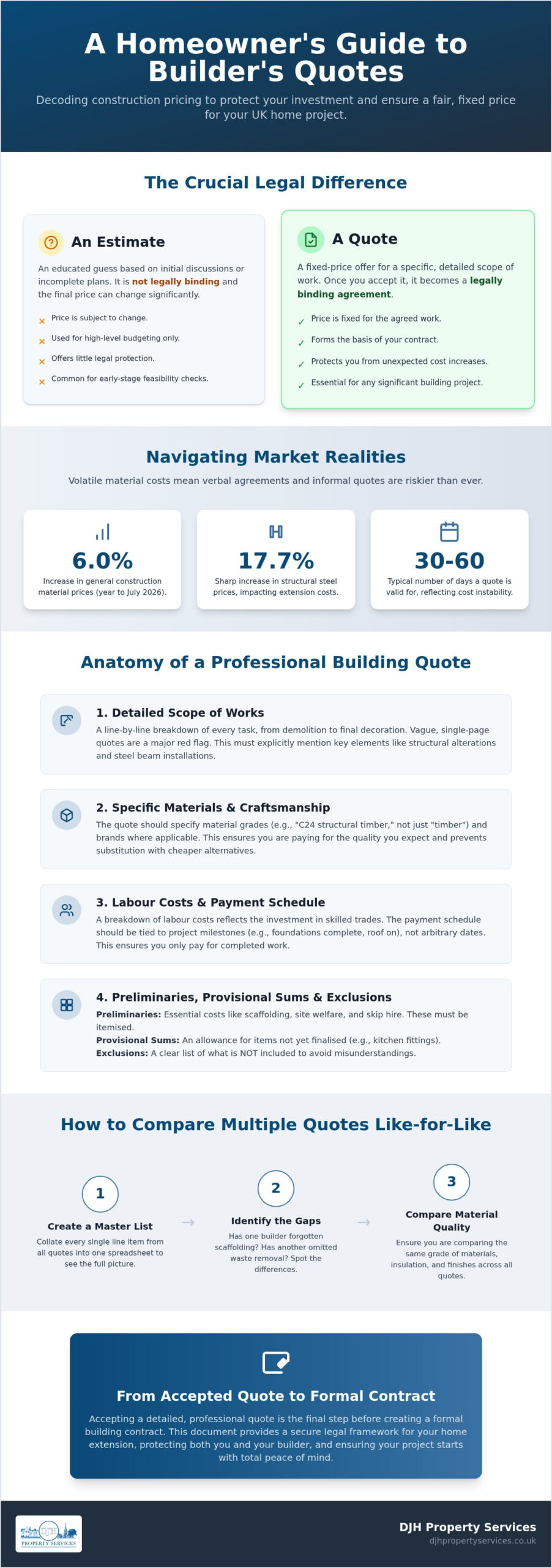
Many homeowners use the terms “estimate” and “quote” interchangeably, but in the UK construction industry, they carry very different legal weights. An estimate is an educated guess. It’s usually based on incomplete information or early-stage discussions. Conversely, a quote is a fixed price for a specific scope of work. When you’re looking for a builder’s quote explained UK regulations and standards dictate that once accepted, a quote becomes a formal offer that the builder is obliged to honour.
Relying on verbal agreements or “WhatsApp quotes” is a significant risk. These informal messages often lack the detail required to protect you if costs spiral. In 2026, the market is particularly volatile. With construction material prices rising by 6.0% in the year to July 2026, and structural steel seeing even sharper increases of 17.7%, a casual message isn’t a sufficient safeguard for your investment. Most professional builders now limit quote validity to 30 or 60 days. This reflects the “stair-step” pattern of cost increases we’re seeing across the industry, making long-term price guarantees difficult without a formal contract.
When an Estimate is Appropriate
An estimate serves a vital purpose during the initial feasibility stages of a project. If you’re exploring a home extension in Salisbury but haven’t finalised architectural drawings, an estimate helps you understand if your vision aligns with your budget. It’s also necessary when “opening up” older properties. Until we see what’s behind a century-old wall or beneath the floorboards, a fixed price is often impossible. Use an estimate for high-level budgeting, but don’t treat it as a final figure until the full scope is known.
The Binding Nature of a Written Quote
A written quote is more than a list of prices; it’s the foundation of a legally binding agreement between you and your contractor. Under UK law, if a builder provides a fixed quote, they cannot simply increase the price midway through because they underestimated the labour required. However, you must understand the role of “variations”. If you decide to change the kitchen layout or upgrade the roofing materials after the work has started, these changes will alter the fixed price. A professional builder will always document these variations in writing to maintain transparency and ensure the final bill doesn’t come as a surprise.
The Anatomy of a Professional Building Quote: What Must Be Included
A professional quote is more than a final sum; it’s a comprehensive technical document. It serves as the master plan for your project’s finances and execution. When you have a professional builder’s quote explained UK standards require a granular look at the resources allocated to your home. This transparency builds the foundation of a successful working relationship and ensures that every pound spent is visible and justified.
Breaking Down the Scope of Works
A single-page quote for a major home extension is a red flag. It suggests a lack of foresight that often leads to disputes. A robust proposal features a line-by-line breakdown of every task. Structural alterations and steel beam installations must be explicitly mentioned to ensure they are included in the fixed price. A clear, itemised scope protects both the builder and the client by defining the exact boundaries of the project from the outset.
Materials and Craftsmanship Standards
Vocabulary matters. A vague mention of “timber” is insufficient. A professional quote specifies “C24 structural timber” or specific brands of high-performance insulation. There is a significant difference between standard builders’ grade materials and the premium finishes required for a legacy home. Professional bricklaying and carpentry require specific line items to reflect the high level of skill involved. When vetting Construction Builders in Salisbury, look for this level of detail as a marker of quality.
Labour costs should reflect the time required for skilled trades. The UK construction industry needs to recruit 41,200 additional workers each year until 2030, so skilled labour is a significant investment. Your payment schedule must be tied to physical milestones rather than calendar dates. A standard professional schedule often includes:
- Initial Deposit: Usually for material procurement and site mobilisation.
- Groundworks: Payment upon completion of foundations and drainage.
- Wall Plate: Payment once the shell and structural alterations are complete.
- Watertight Stage: Following the completion of roofing and windows.
To secure a realistic quote from a builder, you should demand a schedule that ensures you only pay for verified progress. For those seeking a transparent partner for home alterations, our methodical quoting process provides the clarity you need to move forward with confidence.
Managing the ‘Unknowns’: Provisional Sums, Preliminaries, and Exclusions
A transparent building proposal must account for the logistical realities of a construction site, not just the finished structure. When you see a builder’s quote explained UK standards typically group these operational costs under the heading of ‘preliminaries’. These are the essential services that allow a project to function safely and legally. Alongside these, you will find ‘Provisional Sums’ and ‘Prime Cost Sums’, which handle the elements of your project that haven’t been fully specified at the time of pricing.
The Reality of Preliminaries in Salisbury
In our local area, preliminaries often involve complex logistics that a non-local contractor might overlook. Navigating the narrow Wiltshire streets requires careful planning for skip placement, skip permits, and scaffolding requirements. Preliminaries also cover essential site welfare facilities for the tradespeople, site insurance, and professional indemnity. These costs are non-negotiable for a safe, professional site. You should view preliminaries as the ‘engine room’ of the building project; without them, the physical work cannot proceed efficiently or safely.
Provisional Sums: The ‘Fair’ Way to Price the Unknown
Provisional Sums (PS) are allowances used when specific finishes, such as a bespoke kitchen or a particular style of bathroom tiling, haven’t been chosen yet. They keep a quote realistic by providing a placeholder figure. However, a common industry pitfall is ‘low-balling’ these sums to make a total quote appear more attractive. If a builder allocates a small sum for a kitchen that clearly requires a much larger investment, you’ll face a significant and stressful bill later. At DJH Property Services, we organise provisional sums based on our decades of local experience to ensure they are grounded in reality rather than optimism.
Prime Cost Sums (PC) are slightly different. These are fixed allowances for the purchase of specific materials where the builder’s labour is already known and priced. Finally, always scrutinise the ‘Exclusions’ list. This section clearly states what the builder is definitely not doing. It’s common for internal decoration, floor coverings, or external landscaping to be excluded to keep the core construction costs distinct. Understanding these categories ensures your final bill aligns with your initial expectations, providing the peace of mind that comes from a truly professional agreement.
How to Compare Multiple Building Quotes Like-for-Like
Receiving three different prices for the same project can be disorienting. To find the true value, you must perform a ‘tender analysis’ by normalising each proposal. This means checking that every builder has accounted for the same essential elements. For example, did one contractor omit the skip hire or the building control fees? When you have a builder’s quote explained UK tax laws are another critical variable. Ensure every figure either includes or excludes the standard 20% VAT consistently; otherwise, your comparison will be skewed by thousands of pounds from the outset.
You must also evaluate the ‘Validity Period’ of each document. With construction material prices rising by 6.0% in the year to July 2026, a quote from six months ago is no longer a reliable metric. Tender prices are forecast to rise by a further 2.9% by the end of 2026, so ensure you aren’t comparing a historic price with a current, realistic one. A quote that is several months old will almost certainly lead to price adjustments once the work begins.
Spotting the Red Flags in a Cheap Quote
A significantly lower price is rarely a bargain. It usually signals a lack of ‘making good’ or lower material specifications that will cost you more in maintenance later. There is also the risk of ‘price creeping’, where a builder starts with a low figure only to add ‘extras’ for work that was always essential to the structural integrity of the build. Look closely at the labour inclusions. Professional firms use specialist bricklayers and carpenters for core structural work, whereas a cheaper quote might rely on general labourers for tasks that require a high level of technical skill.
Local Salisbury Considerations
In our region, local knowledge is invaluable for accurate pricing. A professional quote should explicitly account for Wiltshire Council building control inspections and the specific logistics of working in our local area. If you are planning Home Extensions Salisbury homeowners often find that period properties in the historic centre require specific structural considerations that a generalist might miss. Comparing quotes like-for-like ensures you choose a partner who understands these local nuances and the heritage of Wiltshire’s architecture. For a thorough and transparent assessment of your next project, you can request a detailed proposal from our team.
From Paper to Groundwork: Finalising Your Contract with DJH Property Services
Accepting a proposal is a significant milestone, but the transition from paper to groundwork requires a formal structure. Once you’ve had a builder’s quote explained UK homeowners should move toward formalising the agreement through a recognised industry contract, such as those provided by the JCT or the FMB. These documents turn a detailed quote into a robust legal framework that protects both parties. At DJH Property Services, we view this stage as the start of a professional dialogue. A detailed quote provides the clarity needed to set a realistic programme of works, ensuring that expectations around milestones and finishes are perfectly aligned before the first spade hits the ground.
Setting a realistic start date is equally vital. In the current 2026 climate, the construction industry faces an annual requirement for 41,200 new workers, meaning skilled trades are in high demand. We provide honest lead times for our carpentry, bricklaying, and roofing teams. This ensures that once we arrive on site, your project proceeds without the stop-start delays that plague poorly planned builds.
The DJH Commitment to Transparency
Our methodical approach is rooted in over 50 years of industry experience. We focus exclusively on residential construction and home extensions within the Salisbury area, which allows us to price with surgical precision. By providing a granular breakdown of costs for core trades, we eliminate the ambiguity that often leads to “unforeseen” extras. Because we deliver our skilled trades directly rather than relying on faceless subcontracting for core work, we maintain absolute control over the budget. This historical weight and local expertise mean we’ve seen almost every structural challenge Salisbury’s diverse housing stock can offer.
Next Steps for Your Salisbury Project
To move your project forward, we invite you to arrange a site visit. This allows us to review your site logistics and architectural drawings in person, resulting in a comprehensive, itemised quote that leaves nothing to chance. Having your drawings ready ensures a more accurate pricing exercise and helps us identify any specific structural requirements early. Whether you’re planning a complex loft conversion or a significant home alteration, Dan and the team are available for a professional consultation to discuss your vision. Having a builder’s quote explained UK homeowners can trust is the first step toward a successful build, and we’re here to guide you through every stage of the process.
Securing Your Salisbury Build with Confidence
Navigating the complexities of construction pricing in 2026 requires a steady hand and a clear understanding of the technical details. You now know that a professional builder’s quote explained UK regulations is a binding commitment rather than a mere guess. It must account for the local logistics of Salisbury and the rising costs of materials. By scrutinising the preliminaries and demanding a transparent scope of works, you protect your investment from the very first day. These documents aren’t just lists of prices; they’re the foundation of a successful partnership.
With over 50 years of construction experience in Salisbury, DJH Property Services remains dedicated to high-quality home extensions and structural alterations. We’re members of the local building community who prioritise skilled trades and honest dialogue. We’re ready to help you turn your architectural plans into a tangible, lasting reality. Request a Transparent, Itemised Quote from DJH Property Services to begin your journey with a partner you can trust. Your next home project is an investment in your future, and it deserves the care of a seasoned professional.
Frequently Asked Questions
How many builders’ quotes should I get for a home extension?
You should aim to receive three detailed quotes for any significant home extension. Getting three proposals provides a clear benchmark for local Salisbury market rates without causing unnecessary confusion. It allows you to identify where one builder may have misunderstood the scope or where another is offering a more comprehensive service. When you have a builder’s quote explained UK standards suggest that a trio of responses is the most effective way to ensure fair value.
Why is there such a big price difference between my building quotes?
Discrepancies often arise from differences in material quality or the inclusion of essential site logistics. One builder might specify premium C24 timber whilst another uses a lower grade. Additionally, “preliminaries” like scaffolding and skip permits in Salisbury’s narrow streets are frequently omitted by less experienced contractors to make their price appear lower. A professional proposal should provide a line-by-line breakdown to ensure you aren’t comparing a comprehensive service with a partial one.
Is a builder’s quote legally binding in the UK?
Yes, a written quote is a legally binding offer once you accept it. Unlike an estimate, which is merely an educated guess, a quote fixes the price for a specific set of works. Under UK law, the builder is obliged to complete the project for that sum unless you request changes. This provides essential peace of mind for homeowners worried about spiralling costs, provided the initial document clearly defines the full scope of the construction.
What are ‘provisional sums’ and how do they work?
Provisional sums are financial placeholders for items or tasks that cannot be accurately priced at the start. For example, you might not have chosen your specific kitchen or bathroom tiles yet. The builder includes a realistic allowance based on their experience to ensure the total budget remains functional. It’s a fair way to manage unknowns, provided the builder doesn’t “low-ball” these figures just to win the contract with an artificially low total.
Do builders’ quotes usually include VAT?
Most residential construction quotes for extensions and alterations include VAT at the standard rate of 20%. However, certain projects like the renovation of properties empty for over two years may qualify for a reduced 5% rate. You should always check if the final figure is “VAT inclusive” to avoid a surprise 20% addition to your bill. Professional builders in Salisbury will always clearly state the VAT status on their formal documentation.
What should I do if the builder’s final bill is higher than the quote?
First, review your original quote against any “variations” you requested during the build. A fixed quote cannot be increased simply because the builder underestimated the labour required. However, if you asked for additional structural alterations or higher-spec materials, these will naturally increase the final cost. Transparent communication is key; every change to the price should have been agreed in writing before the additional work was carried out by the team.
How long is a builder’s quote typically valid for in 2026?
In 2026, most quotes are valid for only 30 to 60 days. This reflects the current volatility in the UK construction market, where material prices rose by 6.0% in the year to July 2026. Fabricated structural steel alone saw a 17.7% increase in the same period. Builders cannot guarantee prices for long periods without risking their business, so it’s important to move from an accepted quote to a formal contract within this validity window.
Should I pay a deposit before receiving a detailed quote?
You should never pay a deposit before you have received and accepted a detailed, itemised quote. A quote is the foundation of your agreement; it defines what you are paying for and the standards of craftsmanship expected. Once the quote is accepted and a formal contract is signed, a small deposit for site mobilisation or material procurement is standard. This sequence ensures your investment is protected and the project begins with clear, documented expectations.