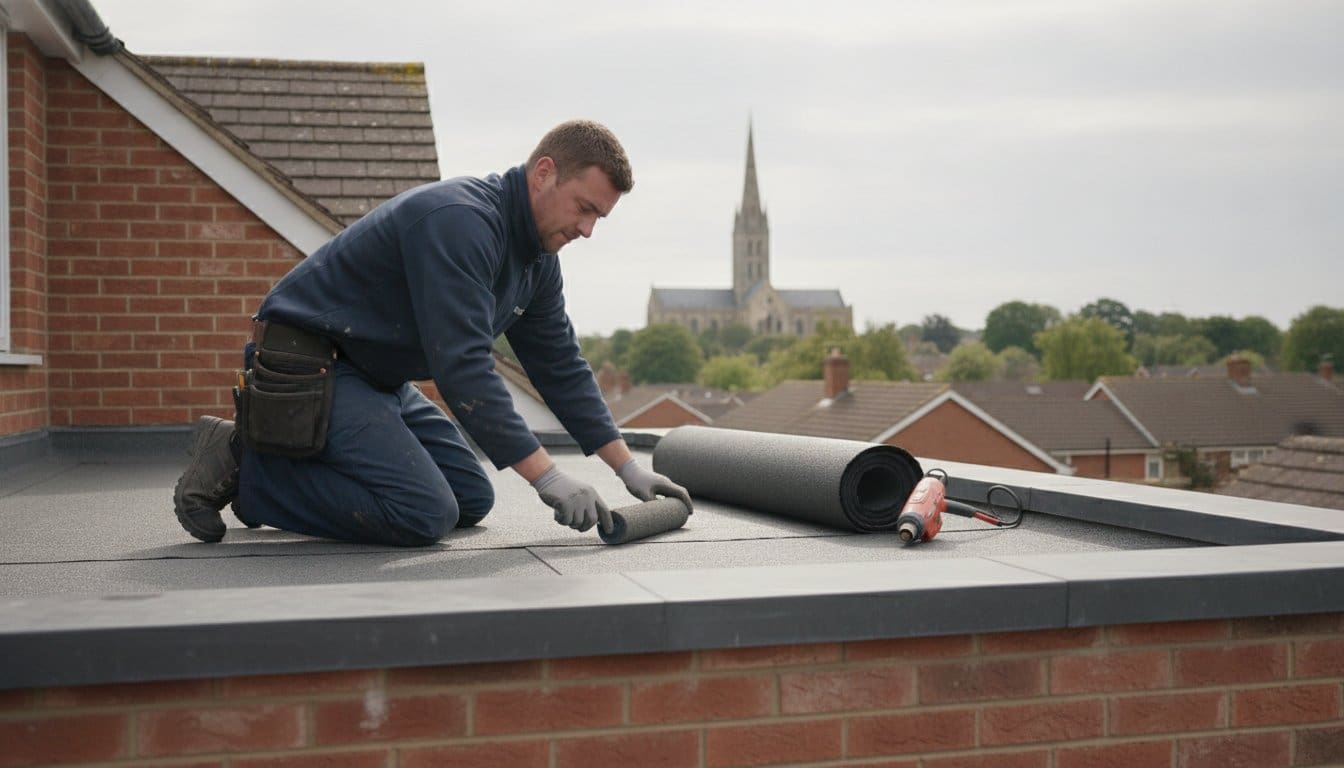
What if the damp smell in your extension isn’t a ventilation issue, but the first sign of a structural failure? For many homeowners, the reality of a failing roof only becomes clear once a ceiling begins to sag or water marks appear, yet the damage often begins months before it is visible. When you are met with conflicting advice from different tradespeople, finding a clear path forward for flat roof repair Salisbury can feel overwhelming. You need a reliable assessment that values craftsmanship and the long-term security of your home.
We understand the frustration of dealing with persistent leaks and the uncertainty of whether to patch or replace. This guide is designed to help you identify the specific symptoms of flat roof failure and understand the professional repair options available for Salisbury properties. We will explore the cost-benefit of different materials, whilst providing the information you need to ensure your home remains dry, warm, and structurally sound.
Key Takeaways
- Recognise early warning signs like “ponding” to prevent minor leaks from becoming major structural concerns.
- Understand the common causes of failure and how professional flat roof repair Salisbury can address age-related degradation or poor previous workmanship.
- Learn how to evaluate the condition of your roof membrane to determine if a cost-effective repair or a full replacement is the most sustainable choice.
- Discover the essential steps in a professional repair, focusing on meticulous surface preparation and the vital need for a completely dry deck.
- Implement a proactive maintenance schedule to protect your investment from the specific challenges of the damp Wiltshire climate.
Identifying Flat Roof Issues in Salisbury Homes
Identifying a problem before it necessitates a total overhaul is the hallmark of a diligent homeowner. In Salisbury, where many properties feature extensions with traditional felt or modern membranes, the signs of failure are often subtle at first. A faint, musty odour in a utility room or a tiny patch of peeling paint in the corner of a ceiling are frequently the first indicators that the external barrier has been breached. If left unaddressed, these minor symptoms can lead to significant structural timber rot, which is far more complex to rectify than a standard flat roof repair Salisbury.
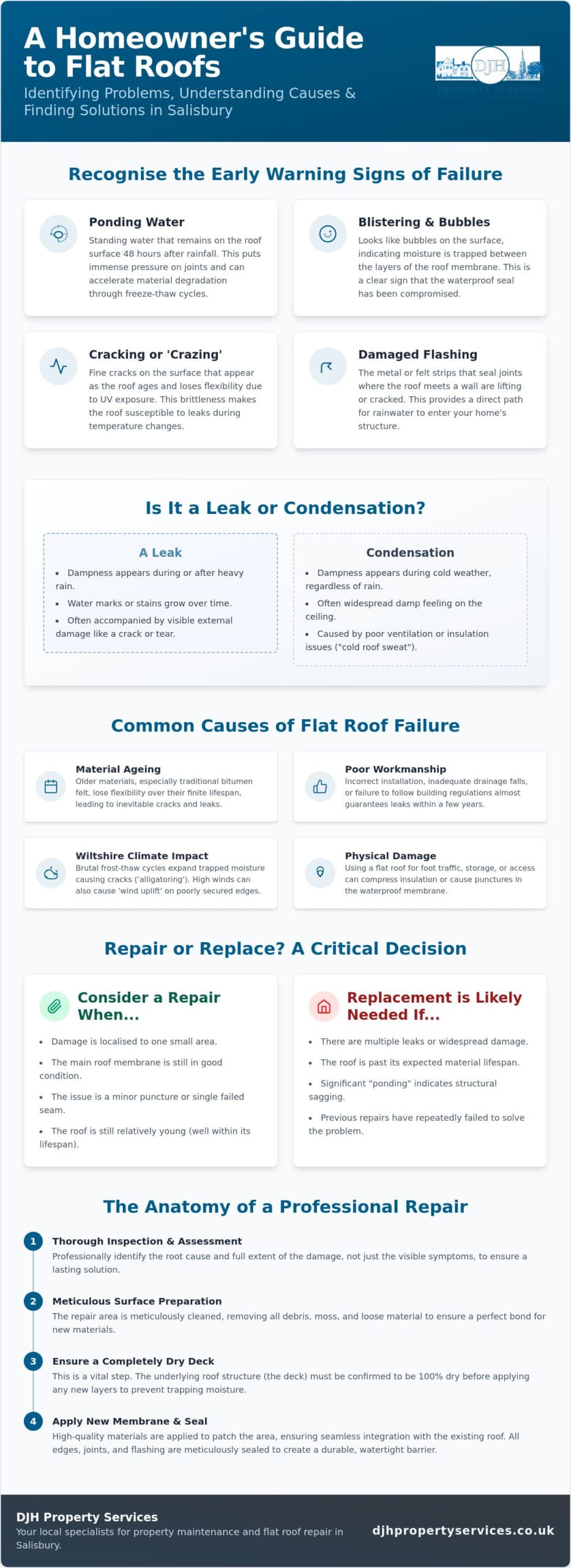
One of the most visible red flags is “ponding,” or standing water that remains on the surface 48 hours after rainfall. Whilst flat roofs are never perfectly level, they should have a recommended fall of 1:80 to ensure efficient drainage. When water sits in pools, it puts immense pressure on the joints and accelerates the degradation of Common flat roof materials. Over time, this standing water can seep through microscopic cracks, especially during the colder months when that water freezes and expands, widening the gaps through a process known as freeze-thaw action.
A thorough external inspection can reveal issues before they manifest inside. Look for “blistering,” which looks like small bubbles on the surface; this indicates that moisture is trapped between the layers. Cracks or “crazing” often appear as the roof ages and loses its flexibility due to UV exposure. You should also pay close attention to the flashing, which are the metal or felt strips that seal the joints where the roof meets a wall. If these are lifting or cracked, they provide a direct path for rainwater to enter your home’s structure. Proactive maintenance in these areas is the most effective way to avoid a full-scale flat roof repair Salisbury.
Is it a Leak or Just Condensation?
Older extensions in Salisbury often suffer from “cold roof” sweat, which is frequently mistaken for a puncture. This occurs through thermal bridging, where warm, moist air from inside the home hits the cold underside of the roof deck. If your ceiling feels damp during a cold snap but stays dry during heavy rain, you likely have a ventilation issue rather than a leak. Distinguishing between these two is vital; a patch won’t stop condensation, but improved airflow or updated insulation will.
The Impact of Salisbury Weather on Flat Roofs
The Wiltshire climate presents specific challenges that homeowners must manage. Frost-thaw cycles are particularly brutal on older bitumen roofs, as the constant expansion and contraction of trapped moisture can cause the surface to “alligator” or crack. Additionally, properties in exposed areas around Salisbury Plain may face wind uplift, where high gusts get under the edges of poorly secured felt. Keeping gutters clear of debris from local trees is also essential to prevent water from backing up under the flashing and causing internal dampness.
Common Causes of Flat Roof Failure: Why Repairs Become Necessary
Understanding why a roof has failed is the first step toward a permanent solution. In our experience, flat roof issues rarely stem from a single event; they’re usually the result of gradual environmental stress or historical installation errors. While modern materials are exceptionally durable, many older extensions in the city still rely on traditional bitumen felt, which has a finite lifespan. When this material reaches the end of its functional life, it loses the flexibility required to cope with temperature changes, leading to the cracks and leaks that necessitate a professional flat roof repair Salisbury.
The geology of Wiltshire also plays a surprising role in roofing longevity. Salisbury sits on a mix of chalk and clay-rich soils, which are prone to seasonal shifting. This subtle structural movement can put immense pressure on roof joins and where the flat roof meets the main masonry of the house. If the roof wasn’t installed with enough “give” to account for this movement, the membrane can tear or pull away from the walls. Furthermore, we often find that “cowboy” builders or well-meaning DIY enthusiasts fail to follow UK building regulations for roofs, particularly regarding structural support and drainage falls. Skipping these essential steps almost guarantees a leak within a few years of installation.
Inappropriate use is another common culprit. Many homeowners treat a flat roof as an impromptu balcony or a platform for window cleaning. Unless the deck was specifically reinforced for foot traffic, the weight can compress the underlying insulation or puncture the membrane. Regular property maintenance can help identify these punctures before they allow water to rot the structural timbers beneath.
Material Breakdown: Felt vs. GRP vs. EPDM
Traditional felt roofs often fail through “alligatoring,” where UV rays dry out the bitumen until it cracks like reptile skin. GRP, or fibreglass, is incredibly tough but can be prone to “pinholing” if the resin wasn’t applied correctly during a damp spell. In contrast, modern EPDM rubber membranes offer superior durability because they remain flexible for decades, making them much more resistant to the structural shifts common in Salisbury properties.
The Role of Flashing and Joinery
Most leaks don’t actually start in the centre of the roof; they begin at the edges. In Salisbury’s many period properties, the lead flashing that seals the gap between the roof and the brickwork can perish or pull loose over time. If your guttering is blocked or poorly aligned, water can back up against the roof edge, leading to rot in the fascia boards and the roof deck. Ensuring these joins remain watertight is a critical component of any flat roof repair Salisbury.
Repair vs. Replace: Evaluating Your Flat Roof’s Condition
Deciding whether to invest in a flat roof repair Salisbury or opt for a complete overhaul requires a methodical assessment of the existing structure. It isn’t just about stopping a drip; it’s about evaluating if the roof’s current state can support a long-term fix. We generally look at three critical factors: the percentage of the surface that’s damaged, the age of the material, and the integrity of the timber deck beneath. If the damage is localised to a small area, a repair is often the most sensible and cost-effective route. However, when faults cover more than 25% of the roof, the cost of multiple patches often approaches the price of a full replacement.
The age of your roof membrane is a significant factor in this decision. Traditional bitumen felt roofs that have surpassed the 15-year mark often become brittle and lose their ability to expand with the weather. In these instances, patching one leak often puts pressure on the next weakest point, leading to a cycle of recurring issues. Following professional roof maintenance guidelines, we also check for moisture entrapment. If water has seeped into the insulation or the timber decking, a surface patch won’t solve the problem. Structural rot in the joists is a serious concern that requires immediate attention to keep your home secure.
When a Targeted Repair is Sufficient
If your roof is relatively young and the membrane remains supple, targeted interventions are highly effective. Fixing isolated punctures, treating small blisters, or resealing joins on an otherwise healthy EPDM roof can extend its lifespan by several years. We frequently find that replacing specific sections of failing flashing in Salisbury’s period properties is all that’s required to restore a watertight seal. These repairs are unhurried and precise, focusing on maintaining the existing craftsmanship of your property without the need for a total rebuild.
Signs That a Full Replacement is Required
There are certain physical cues that indicate a repair is no longer a viable option. A “spongy” or bouncy sensation when walking on the surface is a major red flag; it suggests the timber decking has already succumbed to moisture and lost its structural strength. Likewise, if you’re dealing with widespread saturation of the insulation layer or multiple leaks appearing simultaneously, the system has reached the end of its life. For those facing these issues, our guide on Roof Replacement Salisbury provides detailed guidance on the regulations and material options available.
Step-by-Step Guide: Professional Flat Roof Repair Process
A successful flat roof repair Salisbury is never a rushed endeavour. It requires a methodical sequence that ensures the new material integrates seamlessly with the old. The process begins with meticulous preparation. We remove all traces of moss, silt, and loose debris to expose the true condition of the membrane. Without a pristine surface, even the highest quality sealant will fail to bond, leading to premature failure within months.
Once the surface is clean, ensuring the area is bone-dry is the most critical step. Moisture entrapment is the primary cause of repair failure; if water is locked beneath a new patch, it will expand when heated by the sun, causing the membrane to blister and peel. We use professional drying equipment to ensure the deck is ready. Following this, the chosen material, whether it’s a modern liquid membrane or high-performance torch-on felt, is applied with precision. We pay particular attention to sealing the edges, as these joins are where the integrity of the roof is most often tested.
The final stage of any professional intervention is verification. We often perform a “flood test” on specific areas, where the roof is temporarily plugged and filled with a shallow layer of water. This allows us to confirm the repair is watertight under pressure before we consider the job complete. If you’re concerned about a recurring leak, our team provides professional roofing solutions that focus on these long-term results rather than temporary patches.
The Tools and Materials Professionals Use
Modern liquid-applied coatings have revolutionised the industry, allowing for seamless repairs around complex shapes like pipes or skylights. Unlike the “emergency” tins of sealant found in DIY stores, which are only designed as stop-gaps, professional systems often include a reinforced scrim. This fabric mesh is embedded into the liquid layers to provide structural strength and flexibility, ensuring the repair can withstand the natural movement of the building without cracking.
Safety and Building Regulations
Working at height requires more than just a ladder; it demands proper safety equipment and comprehensive public liability insurance. Every flat roof repair Salisbury must also account for legal requirements. Under Part L of the Building Regulations, if we’re replacing more than 25% of your roof, you may be required to upgrade the thermal insulation to meet modern energy efficiency standards. We work closely with Salisbury building control to ensure every project is compliant, protecting the value and legality of your home.
Protecting Your Investment: Long-term Flat Roof Maintenance
A flat roof should never be viewed as a “fit and forget” feature of your home. To ensure the longevity of the structure, a proactive approach to maintenance is essential. In the damp Wiltshire climate, organic growth such as moss and lichen can quickly take hold. These organisms act like sponges, retaining moisture against the membrane and accelerating the degradation of the surface. Removing this growth gently and scheduling bi-annual gutter clearing prevents water from backing up, which is a common precursor to needing a professional flat roof repair Salisbury.
Maintaining a healthy roof also involves looking at the surrounding structure as a complete system. Quality brickwork and expert carpentry are the foundations of a watertight home. If the parapet walls are crumbling or the timber joists have shifted, even the most expensive membrane will eventually fail. Regular professional surveys allow for the early detection of these peripheral issues; catching a failing lead flashing or a blocked internal drain early often saves homeowners from the expense of significant structural repairs later on. Understanding the full scope of roof leak repair Salisbury specialists recommend, including how 2026 airtightness regulations may affect your maintenance obligations, can help you plan ahead and avoid costly surprises.
Consistency is the key to preservation. We recommend a simple inspection every spring and autumn to check for signs of debris build-up or physical damage after winter storms. This unhurried, methodical oversight ensures that your property remains secure and that any minor issues are addressed before they compromise the interior of your home. For those who also maintain a leisure vehicle, you may wish to explore Motorhome Habitation Service with LeisureVan Service Solutions to ensure your mobile home is as well-cared for as your residence.
Integrating Flat Roofs with Home Extensions
Modern Home Extensions Salisbury residents invest in rely on high-performance materials and precise engineering to create habitable, light-filled spaces. The success of these projects depends heavily on ensuring the correct falls for effective water drainage. When we design and build these extensions, we prioritise the structural integrity of the roof deck to prevent the “ponding” issues that plague older, less carefully constructed builds. A well-integrated flat roof should complement the architecture whilst providing decades of reliable service.
Why Choose a Trusted Salisbury Builder for Repairs?
Choosing a builder with deep local roots provides a level of accountability that national contractors often lack. Local knowledge is invaluable when dealing with Salisbury’s specific architectural mix, from Victorian terraces to contemporary builds. By combining roofing expertise with general building skills, a seasoned professional can identify if a leak is caused by a simple puncture or a deeper structural fault in the masonry or carpentry. This holistic approach ensures that any flat roof repair Salisbury is a permanent solution rather than a temporary fix. Contact DJH Property Services for a professional roof assessment to ensure your home remains dry and protected.
Ensuring a Watertight Future for Your Property
Addressing a leak requires a diagnostic approach that looks beyond the surface. By recognising early warning signs like ponding or damp patches, you can often prevent minor issues from escalating into structural timber rot. Understanding when to choose a targeted repair over a full replacement is vital for managing your home’s maintenance budget effectively whilst ensuring long-term security. A professional flat roof repair Salisbury provides the peace of mind that comes from using high-performance materials and meticulous installation techniques.
With over 50 years of industry experience, DJH Property Services is a Salisbury-based specialist in residential construction. Our team of reliable, skilled tradespeople takes personal pride in every project, ensuring your property remains dry and protected against the Wiltshire elements. We believe in providing honest, expert advice that prioritises the integrity of your home.
Take the first step towards a more secure home today. Request a Professional Roof Survey from DJH Property Services to receive a thorough assessment of your roof’s condition. Your home deserves the care of seasoned professionals who understand the nuances of local architecture.
Frequently Asked Questions
How much does flat roof repair cost in Salisbury?
The cost of a repair depends entirely on the extent of the damage and the materials required to fix it. A minor patch on a relatively modern membrane will be less intensive than a project involving the replacement of saturated insulation or rotten structural timbers. We recommend a professional survey to assess your property’s specific needs and provide an accurate, tailored estimate for the work required.
How long does a typical flat roof repair take to complete?
Most minor repairs are completed within a single day, provided the weather remains dry. If the damage is more extensive and requires the removal of the old deck or the installation of new joists, the process may take two to three days. Our team focuses on working efficiently to ensure your home is made watertight as quickly as possible without rushing the essential drying and bonding stages.
Can I repair a flat roof myself using DIY products?
While emergency sealant tins are available in hardware stores, they are temporary stop-gaps rather than permanent solutions. Professional flat roof repair Salisbury requires specialised equipment to ensure the surface is perfectly dry and the new materials bond correctly. Improperly applied DIY patches often trap moisture beneath the membrane, which can lead to accelerated timber rot and far more expensive structural issues later on.
What is the best material for a new flat roof in the UK?
Modern EPDM rubber and GRP (fibreglass) are widely considered the most reliable options for the British climate. EPDM is favoured for its exceptional flexibility and resistance to UV rays, whilst GRP provides a tough, seamless finish that is ideal for roofs with complex shapes or those that may require light foot traffic. The best choice depends on your property’s architecture and your specific performance requirements.
Does home insurance cover flat roof leaks?
Insurance coverage generally depends on the cause of the leak rather than the roof type itself. Most policies cover “sudden and accidental” damage caused by storms or falling debris. However, leaks resulting from general wear and tear, lack of maintenance, or the natural end of a material’s lifespan are typically excluded. It’s vital to check your specific policy details regarding the age and maintenance requirements of your flat roof.
How do I know if my flat roof timbers are rotten?
The most obvious sign of rotten decking is a “spongy” or bouncy sensation when you walk across the surface. Inside your home, you may notice sagging in the ceiling, persistent damp odours, or visible mould growth in the corners of the room. If the internal plasterwork is cracking where the ceiling meets the wall, it could indicate that the structural joists have been compromised by long-term moisture ingress.
Will a flat roof repair stop condensation in my extension?
A repair will stop rainwater from entering, but it won’t fix a condensation problem caused by poor ventilation. Condensation often occurs in older extensions where “thermal bridging” allows warm air to hit cold surfaces. If your ceiling feels damp during cold snaps but stays dry during heavy rain, you likely need improved airflow or updated insulation rather than a simple patch to the external membrane.
How often should I have my flat roof inspected?
We recommend a professional inspection at least twice a year, ideally in the spring and autumn. Regular checks allow you to clear debris from gutters and identify minor issues like lifting flashing or small blisters before they develop into major leaks. This proactive approach is the most effective way to extend the life of your roof and avoid the need for an emergency flat roof repair Salisbury.