With UK homeowners losing over £10.3 billion to rogue trading and substandard work in 2024, the stakes for your next home project have never been higher. It is a sobering reality that one in four people now report significant issues with their contractors, ranging from abandoned builds to structural defects. You likely feel the weight of this risk, perhaps worrying about financial loss or the sheer stress of managing a live building site. It’s understandable to feel cautious when the peace of your home and the stability of your largest asset are on the line.
This guide provides the clarity you need on how to find a good builder UK homeowners can rely on for high-quality results. We will outline the essential steps for vetting contractors, navigating the 2026 Building Safety Act requirements, and distinguishing between a loose estimate and a binding quotation. By following a methodical approach, you can ensure your extension is handled by seasoned professionals who value clear communication and structural integrity. We will examine the key accreditations to look for and the specific red flags that help you avoid the pitfalls of cowboy builders for good.
Key Takeaways
- Understand the professional distinction between main contractors and specialist tradespeople to ensure your construction project is managed with the correct level of oversight.
- Learn how to find a good builder UK homeowners can trust by implementing a rigorous vetting process that includes verifying insurance and checking for 2026 regulatory compliance.
- Identify the subtle red flags of cowboy builders, such as uncharacteristically short lead times or a reluctance to provide a written, fixed-price quotation.
- Discover the benefits of partnering with a local Salisbury specialist who understands the specific geological and architectural constraints of the Wiltshire area.
- Prepare for a stress-free experience by mastering the art of the initial site visit and knowing which technical questions to ask regarding structural alterations.
Understanding the Building Landscape in the UK
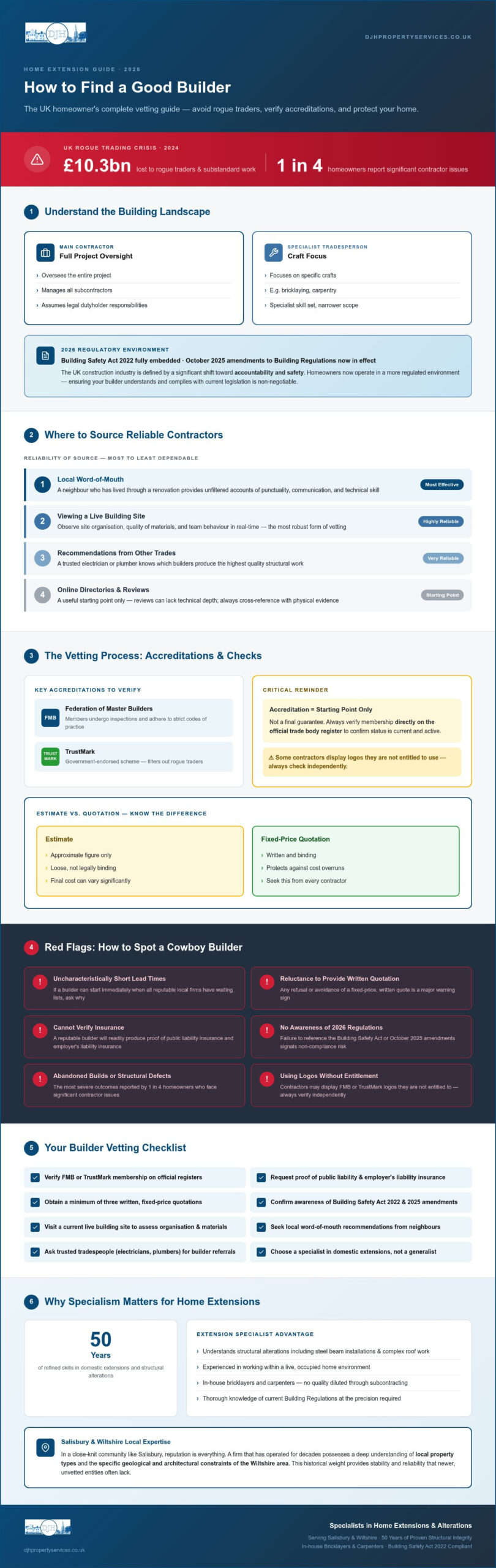
The UK construction industry in 2026 is defined by a significant shift toward accountability and safety. With the Building Safety Act 2022 now fully embedded and the October 2025 amendments to Building Regulations in effect, homeowners face a more regulated environment. Understanding the distinction between a main contractor and a specialist tradesperson is the first step in learning how to find a good builder UK homeowners can trust. A main contractor oversees the entire project, manages subcontractors, and assumes legal dutyholder responsibilities, whereas a specialist tradesperson focuses on specific crafts like bricklaying or carpentry. A good builder is a professional who seamlessly integrates technical craftsmanship with the logistical rigour of project management.
For those in Salisbury and the surrounding Wiltshire area, the value of long-standing industry experience cannot be overstated. A firm that has operated for decades possesses a deep understanding of local property types and the specific challenges of the regional landscape. This historical weight provides a level of stability and reliability that newer, unvetted entities often lack. When you hire a seasoned professional, you aren’t just paying for labour; you’re investing in a legacy of proven structural integrity.
The Role of Trade Bodies and Accreditations
Trade bodies such as the Federation of Master Builders (FMB) and the Government-endorsed TrustMark scheme offer a necessary baseline for vetting. These organisations require members to undergo inspections and adhere to strict codes of practice, which helps filter out rogue traders. It’s vital to remember that accreditation is a starting point rather than a final guarantee of a favourite outcome. You should always verify a builder’s membership directly on the official trade body registers to ensure their status is current and active. This simple check protects you from contractors who might use logos they aren’t entitled to display.
The Importance of Specialism in Home Extensions
Residential extensions require a vastly different skill set than general property maintenance or minor repairs. Structural alterations, such as steel beam installations and complex roof work, demand precision and a thorough knowledge of current Building Regulations. You should favour builders who specialise in domestic extensions because they understand the nuances of working within a live home environment. DJH Property Services focuses on extensions and alterations specifically because these projects allow our in-house bricklayers and carpenters to apply the high-level skills we have refined over 50 years. Choosing a specialist ensures that the core structural elements of your home are handled by experts who do this work every day.
Where to Source Reliable Building Contractors
Sourcing a reliable contractor requires a blend of traditional legwork and digital due diligence. While the internet offers a vast array of options, the most dependable leads often come from your immediate community. Local word-of-mouth remains the most effective tool in your search. A neighbour who has lived through a renovation can provide an unfiltered account of a builder’s punctuality, communication, and technical skill. This direct feedback is invaluable when researching how to find a good builder UK homeowners can trust with their investment.
You might also consult this Citizens Advice guide on finding a trader to understand how to cross-reference online listings. While directories are useful, you should treat them as a starting point. Reviews can sometimes lack technical depth, so it’s wise to supplement digital research with physical evidence. Understanding how to find a good builder UK is often about seeing work in person. Seeing a builder’s current live site is perhaps the most robust form of vetting. It allows you to observe their site organisation, the quality of their materials, and the behaviour of their team in real-time. Don’t overlook recommendations from other skilled tradespeople. A trusted electrician or plumber often knows exactly which builders produce the highest quality structural work.
Leveraging Local Knowledge in Salisbury
In a close-knit community like Salisbury, reputation is everything. If you are planning home extensions Salisbury neighbours have recently completed, take the time to ask about their experience. Look for active projects in your area and take note of the branding on vans and site boards. Local builders are inherently more invested in maintaining their standing within the community because their future work depends on it. They are also more likely to understand the specific architectural nuances of Wiltshire’s period properties. If you need assistance with your next project, you can contact our team for expert advice.
Evaluating Online Portfolios and Case Studies
When you transition to online research, focus on the technical details of a builder’s portfolio. Look for high-resolution “before and after” photographs that highlight structural brickwork and fine carpentry. It is essential to identify projects that match the scale and complexity of your own requirements. If you are planning ambitious 100k extensions, a portfolio filled with minor repairs won’t give you the confidence you need. Seek out testimonials that go beyond generic praise. The most useful reviews mention specific traits such as structural precision, adherence to timelines, and how tidy the team kept the site during the build. This level of detail helps you confirm that the builder’s standards align with your expectations for quality and professionalism.
The Vetting Process: Interviewing and Comparing Quotes
Organising a professional initial site visit is more than a mere formality. It’s your first opportunity to witness the steady and methodical approach of a seasoned professional. When considering how to find a good builder UK residents should watch for punctuality and the depth of the builder’s initial assessment. A contractor who takes detailed measurements and asks probing questions about your specific goals for home alterations is far more likely to deliver a precise result than one who offers a cursory glance. This meeting sets the tone for the entire project, establishing whether the builder prioritises thoroughness over speed.
During this visit, you must address the technical realities of your project. If your extension involves structural alterations or steel beam installations, ask the builder to explain their process for temporary support and load bearing. A dependable builder will be happy to discuss how they adhere to GOV.UK building regulations approval guidelines to ensure the structural integrity of your home. They should demonstrate a clear understanding of the legal dutyholder regime, which requires contractors to verify their competence before commencing work. This technical dialogue is essential for your peace of mind and the long-term safety of the construction.
Key Questions for Your Potential Builder
Transparency regarding the workforce is a hallmark of a reliable firm. Ask specifically who will be on-site daily. Firms with in-house trades, particularly in core areas like bricklaying and carpentry, often maintain higher standards of quality control than those who rely entirely on unvetted sub-contractors. You should also enquire about their protocol for unforeseen structural issues. A seasoned professional won’t promise a problem-free build; instead, they will explain how they communicate and resolve challenges as they arise. Finally, request proof of insurance. Ensure they hold Public Liability insurance of at least £2,000,000 and statutory Employers’ Liability insurance of £5,000,000 if they employ staff.
Analysing the Quote: Beyond the Bottom Line
A detailed, itemised quote is vastly superior to a single-page estimate. An estimate is often just an educated guess, whereas a written quotation forms a binding contract. Ensure the document clearly includes essential costs such as waste removal, scaffolding, and all necessary materials. You must also check if the 20% VAT is clearly stated. Many homeowners face “hidden” costs when VAT is omitted from the initial headline figure. Be wary of the cheapest quote. A significantly lower price often indicates a lack of experience, an attempt to use inferior materials, or the omission of critical project stages. When you look at how to find a good builder UK, remember that value is found in the completeness of the quote, not just the lowest number.
Identifying Red Flags and Avoiding Cowboy Builders
Recognising the warning signs of a “cowboy” builder early in the process is the most effective way to protect your home and your finances. While the vetting techniques discussed in previous sections provide a strong foundation, you must also remain alert to more subtle indicators of unprofessionalism. The initial enquiry often serves as a litmus test for a contractor’s future performance. Poor timekeeping for a site visit or providing vague, evasive answers to technical questions about brickwork and carpentry are significant warning signs. A builder who lacks the confidence to explain their methods is unlikely to possess the skill required for complex home alterations.
One of the most persistent dangers is the builder who claims they can “start tomorrow.” In the UK construction industry, high-quality firms are almost always in demand and will typically have a lead time of several weeks or months. While a sudden gap in a schedule can occur, an immediate availability often suggests a lack of consistent work or a reputation that doesn’t sustain a steady pipeline. Understanding how to find a good builder UK homeowners can trust means accepting that excellence is worth the wait. You should also observe the behaviour of site staff if you visit a live project. A lack of organisation or a disregard for site safety and tidiness is a clear reflection of the firm’s overall standards.
Subtle Warning Signs in Communication
Clear, documented communication is the hallmark of a seasoned professional. You should immediately distance yourself from any contractor who refuses to provide a formal written contract. Without a contract, you have no legal protection regarding timelines, costs, or quality standards. Be equally wary of anyone who suggests bypassing Building Regulations or working without Building Control oversight. This behaviour isn’t a “shortcut” for your benefit; it’s a serious legal risk that can make your property unsellable and potentially unsafe. A true expert understands that structural integrity and legal compliance are non-negotiable components of any construction project.
Financial Red Flags to Watch For
Financial transparency is essential for peace of mind. A common tactic used by rogue traders is the pressure to pay in cash to “save the VAT.” This is not only illegal but also leaves you with no paper trail, effectively voiding your ability to make insurance claims or enforce warranties. You should never pay the full amount upfront. While a small deposit of 5% to 10% is standard to secure a start date, requests for large sums before materials arrive on-site are a major red flag. Legitimate firms operate with milestone-based payment schedules, ensuring you only pay for work that has been completed and verified. If you want to work with a team that prioritises transparency and quality, book a professional site assessment with DJH Property Services. Following these guidelines on how to find a good builder UK will ensure your project remains on a steady, professional track.
The Benefits of Choosing a Local Salisbury Specialist
While national directories offer a broad starting point, they often lack the granular insight required for a successful build in South Wiltshire. Understanding how to find a good builder UK homeowners can trust involves looking for those with deep roots in their specific locale. Salisbury’s unique geological and architectural profile, from its chalk-river alluvial plains to its medieval timber frames, demands a specialist approach that a national firm cannot replicate. A team that understands the local landscape is better equipped to manage the technical complexities of your project from the ground up.
Local construction builders are intimately familiar with the high water tables and subsoil conditions of the five river basins surrounding the city. This knowledge is critical when planning foundations and drainage for home extensions, as the alluvial plains require specific technical considerations. Managing logistics in our historic, narrow streets also requires a level of coordination that comes only with decades of local experience. These established relationships with Wiltshire Council’s Building Control officers ensure that inspections and completion certificates are handled with professional efficiency, preventing the delays that often plague contractors from outside the area.
Managing Local Planning and Regulations
Salisbury is home to numerous conservation areas and listed buildings where Article 4 directions often restrict standard permitted development rights. A local team understands the necessity of preserving views of the Cathedral spire and using appropriate materials like Chilmark stone or traditional flint. This familiarity with the Salisbury Neighbourhood Development Plan (SNDP 2020-2036) allows for a smoother planning process. With over 50 years of heritage, DJH Property Services brings a level of technical authority to structural alterations that protects the character of your property whilst meeting modern safety standards.
Reliability and Long-term Property Maintenance
Choosing a local authority also ensures long-term accountability. A builder based in your community is far more likely to take personal pride in their craftsmanship, particularly in visible trades like roofing and carpentry. Beyond the initial build, having a partner who provides ongoing property maintenance Salisbury residents can rely on helps protect your investment for years to come. This enduring connection is a key part of how to find a good builder UK clients find truly dependable. Local accountability leads to higher craftsmanship because our reputation is built on the homes we pass every day. If you are ready to discuss your project, contact Dan at DJH Property Services for a professional dialogue.
Securing Your Home’s Future with Professional Excellence
Navigating the complexities of a construction project requires more than just a list of names; it demands a methodical approach to vetting and a commitment to quality. By understanding the legal dutyholder requirements of 2026 and insisting on itemised quotations rather than vague estimates, you protect your investment from the risks of substandard work. Learning how to find a good builder UK homeowners can trust is ultimately about prioritising technical mastery and local accountability over the convenience of a quick start date.
At DJH Property Services, we bring over 50 years of industry experience to every project we undertake. As a Salisbury-based trusted local authority, our team specialises in high-quality bricklaying and carpentry, ensuring that every structural alteration is handled with precision. We invite you to discuss your Salisbury extension project with DJH Property Services to see how our seasoned expertise can bring your vision to life. Building a legacy of quality in Wiltshire has been our focus for decades, and we look forward to helping you achieve a stress-free, successful build. Your home deserves the steady hand of a professional who values craftsmanship as much as you do.
Frequently Asked Questions
How do I know if a builder is reputable in my local area?
A reputable builder is best identified through a combination of local site boards and established community history. In areas like Salisbury, look for firms with decades of active service rather than those with only a digital presence. Asking neighbours about their experiences with specific contractors provides unfiltered insight. A trusted local authority will always be happy to point you toward completed projects in your immediate vicinity to demonstrate their standards.
What insurance should a good builder have in the UK?
A professional builder in the UK must carry Public Liability insurance, typically between £2,000,000 and £5,000,000, to cover accidental damage or injury. If the firm employs staff or apprentices, they are legally required to hold at least £5,000,000 in Employers’ Liability insurance. You should always request to see current certificates before any work begins to ensure your home alterations are fully protected against unforeseen liabilities.
Is it normal for a builder to ask for a deposit upfront?
It is standard practice for a builder to request a deposit of 5% to 10% to secure your place in their schedule. However, you should never pay the full amount before work commences. Staged payments tied to specific project milestones are the safest way to manage finances. When researching how to find a good builder UK homeowners should be wary of any contractor asking for a significant upfront sum for general labour.
How can I check if a builder has experience with home extensions?
You can verify a builder’s experience by requesting a portfolio of their structural work, focusing on projects like house extensions or steel beam installations. Ask for the addresses of local projects they have completed in the last two years. A seasoned professional will provide references from clients who have undertaken similar home alterations, allowing you to confirm their ability to manage projects of your specific scale and complexity.
What should be included in a professional building contract?
A professional building contract should clearly define the scope of work, total cost including VAT, and a milestone-based payment schedule. It must also include start and completion dates, waste disposal arrangements, and insurance details. Using a plain-English contract, such as those provided by the Federation of Master Builders, ensures that both parties understand their obligations. This document is your primary protection against project creep and technical misunderstandings.
How do I handle a dispute with a builder if something goes wrong?
Disputes are best handled by referring to the specific terms outlined in your written contract. You should initiate a calm, professional dialogue with the lead contractor to address the issue immediately. If a resolution isn’t reached, you can seek mediation through trade bodies like the FMB or TrustMark. These organisations provide independent dispute resolution services to help homeowners and builders settle disagreements without the need for expensive legal proceedings.
Why is local knowledge important when extending a Victorian house?
Victorian houses in Salisbury often have unique structural characteristics, such as shallow foundations or specific flint and brickwork patterns. Local knowledge is vital because a builder familiar with Wiltshire’s period architecture will understand how to integrate new extensions without compromising the original building’s integrity. They will also be aware of Salisbury’s conservation area constraints, ensuring your project meets all local planning and building regulation requirements.
Can a builder also handle the roofing and carpentry on my project?
A high-quality main contractor will typically manage all core trades, including roofing and carpentry, to ensure a cohesive build. At DJH Property Services, we provide these skilled trades in-house to maintain strict quality control over the entire project. This integrated approach is particularly beneficial for complex house extensions, as it prevents delays between different stages of construction and ensures the structural shell is finished to a professional standard.