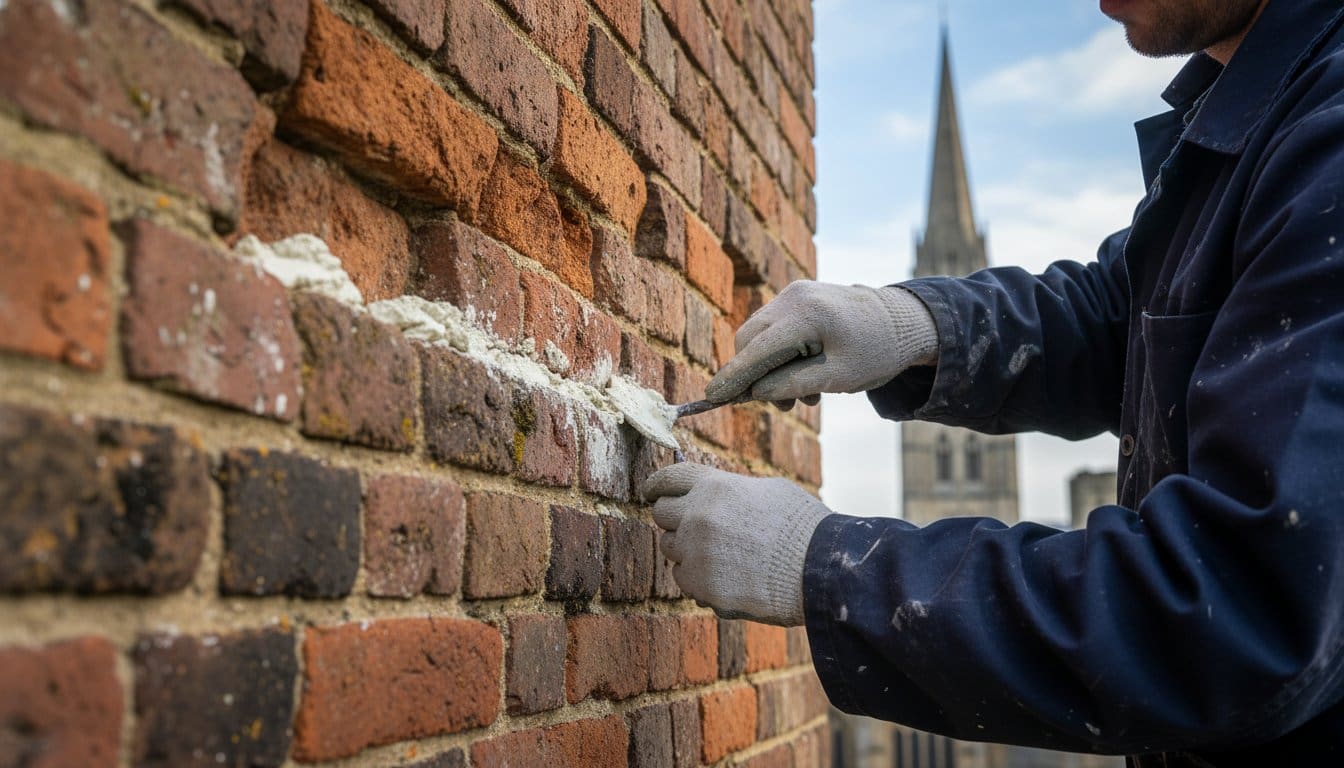
Could a single hairline crack in your masonry be the silent herald of a much larger structural issue? For many homeowners in our historic city, the sight of weathering bricks or failing joints isn’t just a cosmetic concern; it’s a source of genuine anxiety regarding structural integrity and the threat of damp. You want your home to stand firm for another century, yet the fear that modern brickwork repair Salisbury might clash with the unique, weathered hues of local flint and clay is a common hurdle that often delays essential maintenance.
We understand that maintaining a property in a conservation area or a listed building requires more than just a bucket of cement; it demands a deep respect for traditional craftsmanship. This guide will help you navigate the crucial decisions between simple repointing and more complex structural interventions. You’ll learn how to identify the signs of genuine distress, why the choice of mortar is the most important decision you’ll make, and how to find a reliable local bricklayer who treats your home with the care it deserves. By the end, you’ll have a clear roadmap for restoring your property’s strength whilst perfectly preserving its architectural character.
Key Takeaways
- Understand how Salisbury’s damp climate accelerates masonry decay and why historic Victorian or Georgian properties require specific breathable materials for long-term protection.
- Learn to identify the early warning signs of structural distress, such as spalling brick faces and deep mortar erosion, before they lead to significant damp issues.
- Discover the meticulous process involved in professional brickwork repair Salisbury, ensuring damaged sections are replaced safely without compromising the stability of your home.
- Gain insights into preserving local heritage by sourcing reclaimed bricks and using precision mortar tinting to achieve a seamless, invisible finish that matches aged masonry.
- Find out how to select a reliable local partner with the seasoned expertise required to maintain the unique architectural integrity of your property.
Common Causes of Brickwork Decay in Salisbury Homes
Salisbury’s architectural landscape is a tapestry of history, from the timber frames of the city centre to the red-brick Victorian terraces of the surrounding suburbs. However, our local environment presents unique challenges for masonry. The city sits in a river basin, which naturally leads to higher humidity levels and more persistent damp than higher ground. This environmental moisture is the primary catalyst for the decay seen in many local facades. When combined with the natural age of the properties, the process of renewing the pointing becomes essential to prevent structural decline.
Many homeowners feel a sense of dread when they spot a new crack, yet it’s vital to distinguish between historic settlement and active movement. Salisbury’s soil varies across the city, and older buildings often settled into their foundations decades or even centuries ago. These static cracks are frequently cosmetic, though they still require attention to prevent water entry. Active movement, conversely, suggests a current structural shift that demands immediate professional investigation. Addressing these issues early through expert brickwork repair Salisbury ensures that minor cracks don’t evolve into costly structural failures.
Weathering and Moisture Ingress
Salisbury experiences significant rainfall, often driven by prevailing South West winds that batter exposed elevations more severely than others. When brickwork becomes saturated, it is particularly vulnerable to the freeze-thaw cycle. Water expands as it turns to ice, exerting internal pressure that can cause the brick face to flake away. This condition, known as spalling, leaves the soft inner core of the brick exposed to further erosion. Identifying these “blown” faces early is a key step in maintaining the health of your home’s exterior walls.
The Legacy of Incompatible Materials
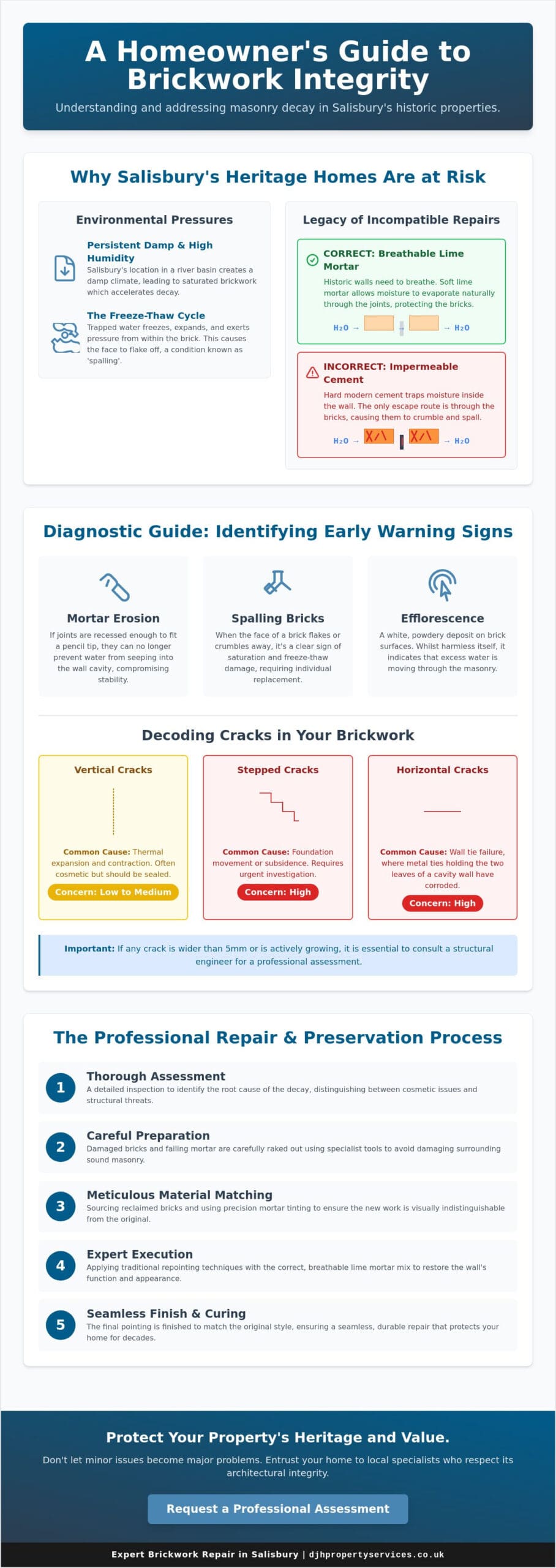
Perhaps the most damaging factor we encounter isn’t the weather, but previous poorly executed repairs. During the mid-20th century, it was common practice to use hard Portland cement for repairs on Victorian and Georgian homes. These older buildings were designed to be breathable, using soft lime-based mortars. Unlike lime, modern cement is impermeable. It traps moisture within the wall, forcing it to escape through the bricks themselves rather than the mortar joints. This leads to internal damp, salt crystallisation, and accelerated masonry decay. Recognising these hard, grey, non-original repairs is the first step in restoring the historical integrity of your masonry.
Identifying Your Brickwork Issues: When to Worry
Homeowners often struggle to distinguish between the natural ageing of a property and signs of genuine structural distress. Whilst some wear is expected in Salisbury’s historic houses, certain symptoms indicate that the protective envelope of your home is failing. A thorough inspection is the first step in any successful brickwork repair Salisbury project, allowing you to address minor issues before they necessitate a major restoration programme.
Mortar erosion is perhaps the most frequent concern. If you can fit the tip of a pencil into the recesses between your bricks, the mortar has likely eroded beyond its effective depth. This allows rainwater to sit within the joints, eventually seeping into the internal leaf of the wall. When this happens, the structural stability of the masonry is compromised. You might also notice spalling, where the brick faces begin to flake or crumble. This is a clear sign that the bricks are saturated and failing under environmental pressure, often requiring the replacement of individual units to restore the wall’s integrity.
Diagnostic Guide for Masonry Cracks
Cracks in brickwork are not always a cause for alarm, but their orientation tells a story. Vertical cracks often result from thermal expansion and contraction, which is common in South West properties. Horizontal cracks, however, can signal the failure of metal wall ties, whilst “stepped” cracks that follow the mortar lines are frequently associated with subsidence or foundation movement. If a crack is wider than 5mm or continues to grow, it is advisable to consult a structural engineer. For cosmetic or non-active cracks, a skilled bricklayer can perform a seamless repair that stabilises the area.
Spalling and Efflorescence
Efflorescence appears as a white, powdery deposit on the surface of your bricks. This is caused by salt-laden water evaporating from the masonry. Whilst the powder itself is harmless, its presence confirms that water is moving freely through your walls. If left unaddressed, this moisture leads to spalling, a more serious condition where the brick’s structural face detaches. This process is often detailed in technical guidance such as Repointing Mortar Joints in Historic Masonry Buildings, which emphasises that porous bricks must be allowed to breathe to avoid such decay. If you notice these symptoms, a professional assessment from DJH Property Services can help determine the best course of action.
Leaning or bulging walls are the most urgent warning signs. A bulge usually indicates that the inner and outer skins of a cavity wall have separated, often due to rusted wall ties. This requires immediate intervention to prevent a partial collapse. By identifying these issues early, you protect both the value of your property and the safety of those within it.
The Professional Brickwork Repair Process
Executing a successful brickwork repair Salisbury requires more than just technical skill; it demands a methodical approach that respects the original builder’s intent. When a property has suffered from the weathering or incompatible materials discussed earlier, the restoration must be handled with precision to ensure the new work is both structurally sound and visually seamless. A disciplined process prevents further damage and ensures the longevity of the repair, maintaining the building’s envelope against the persistent West Country damp.
The first stage involves careful preparation. We don’t simply apply new mortar over the old; instead, we rake out the failed joints to a consistent depth, usually twice the width of the joint. This creates a clean “key” for the new material to bond with. For Salisbury’s older properties, this is often done using hand tools. Whilst mechanical grinders are faster, they carry a high risk of scarring the edges of historic, soft-red bricks. A hand-tooled approach preserves the sharp lines of the masonry, ensuring the finished result looks like a restoration rather than a patch.
Structural Brick Replacement
When individual bricks have spalled or cracked through the core, they must be “toothed out”. This involves removing the damaged unit and its surrounding mortar without disturbing the stability of the adjacent masonry. It’s a delicate task that requires a steady hand. If we’re replacing multiple units in a load-bearing section, the use of temporary supports, such as Acrow props, is essential to prevent the wall from dropping. Once the void is prepared, the new brick is bedded in mortar that matches the strength of the original, ensuring the load is distributed evenly across the facade.
Expert Repointing Techniques
The choice of joint profile is as much about function as it is about form. In our local climate, a “weathered” joint-where the mortar is slightly sloped to shed water-is often the most practical choice. It prevents rain from sitting on the ledge of the brick, reducing the risk of the freeze-thaw damage mentioned in previous sections. For heritage restorations, a “flush” or “recessed” joint might be required to maintain historical accuracy.
The mortar itself is mixed using specific local sands to replicate the regional Salisbury colour palette. We avoid the grey, lifeless finish of modern cement, opting instead for blends that age gracefully. Once the mortar is thumb-print hard, it’s struck to the desired profile and brushed to remove any “laitance” or surface cream. This final step reveals the aggregate and ensures the new pointing blends perfectly with the aged character of your home.
Matching Materials: Preserving Salisbury’s Heritage
The visual character of Salisbury is defined by its distinctive masonry, from the warm, hand-pressed reds of Victorian terraces to the flint-knapped walls of the Cathedral Close. When undertaking brickwork repair Salisbury, the primary challenge is not merely structural; it is the art of invisibility. A repair that stands out as a “patch” fails to respect the history of the building and can even negatively impact its market value. Achieving a seamless finish requires a deep understanding of local material history and a commitment to sourcing authentic components.
Historically, much of the city’s brickwork originated from local kilns, such as those once found in the Fisherton area. These bricks possess a specific porosity and a varied colour palette that modern, mass-produced alternatives cannot replicate. Professional restoration involves identifying these nuances, ensuring that any new additions share the same mineral composition and thermal behaviour as the original fabric. This level of detail is what separates a standard repair from a true heritage restoration. Homeowners who are also considering how to expand their living space whilst maintaining this same material integrity may find it useful to explore options for a bungalow extension Salisbury, where matching new construction to existing masonry presents similar challenges.
Sourcing the Right Brick
Matching a brick involves more than just a quick glance at a colour chart. We look for three critical factors: size, texture, and “frogging”. Many Salisbury homes were built using imperial-sized bricks, which are slightly larger than modern metric versions. Using the wrong size leads to uneven mortar lines that disrupt the bond pattern. We frequently source reclaimed materials from specialist yards across Wiltshire to find bricks with the correct level of weathering and the deep “frog” (the indent on the top) characteristic of Edwardian and Victorian builds. Using a modern “near-match” brick rather than a true reclaimed unit creates a jarring visual patchwork that permanently diminishes your home’s kerb appeal.
Mortar Colour and Composition
The hue of your mortar is dictated almost entirely by the sand used in the mix. Salisbury’s historic mortars often utilised local sands that provided a soft, buff, or slightly orange tint. To replicate this, we perform sand-matching and tinting, often creating several test samples that are allowed to dry completely before we commit to the full elevation. The choice between Lime Putty and Natural Hydraulic Lime (NHL) is also vital; whilst both offer the breathability mentioned in previous sections, their setting times and final strengths vary. We ensure the mortar is always “sacrificial”, meaning it is slightly softer than the brick itself to prevent the masonry from cracking under stress.
Navigating these choices is essential for properties within Salisbury’s conservation areas, where Wiltshire Council may require a “Certificate of Approval” for exterior alterations. If you are concerned about maintaining the historical accuracy of your property, you can contact our team for a professional masonry assessment. Balancing modern building regulations with the demands of heritage conservation is a delicate task, but with the right materials, your home’s character can be preserved for generations.
Reliable Bricklaying and Repairs with DJH Property Services
Entrusting your home’s structural integrity to a contractor requires absolute confidence in their technical ability and their respect for local heritage. Choosing a partner for brickwork repair Salisbury involves more than just finding someone with a trowel; it requires a team that understands the weight of history behind every flint and clay unit. At DJH Property Services, we bring over 50 years of collective industry experience to every project, ensuring that every restoration is handled with the steady, unhurried precision your property deserves.
Our capabilities extend far beyond simple aesthetic fixes. We provide a comprehensive approach to property care, ranging from minor property maintenance and specialist bricklaying to significant home extensions and alterations. This breadth of expertise means we don’t just look at a crack in isolation. We evaluate how the entire building envelope, including roofing and carpentry elements, interacts with the masonry to ensure a permanent solution rather than a temporary patch.
Why Local Expertise Matters
Salisbury’s residential architecture is a unique blend of eras, each with its own structural quirks and material requirements. Our history of working on these diverse buildings has established us as a trusted local authority in the building trade. We understand how the river basin’s humidity affects Victorian lime mortar and how to integrate modern construction standards without compromising the soul of a historic home. As a multi-trade team, we offer a seamless service for complex structural alterations. This eliminates the stress of coordinating different contractors, providing you with a single, reliable point of contact who takes personal pride in the finished result.
Get Your Project Started
We believe that professional dialogue is the foundation of a successful restoration. Our commitment to high-quality craftsmanship is backed by our status as a TrustMark registered business and our established presence on Checkatrade, giving you the peace of mind that your home is in capable hands. Our process is methodical and transparent. It begins with a detailed site assessment to identify the root causes of masonry decay, followed by a clear, unpressured quote that outlines the scope of work required. If you want to ensure you are engaging the right expertise from the outset, our guide on selecting a home improvement contractor Salisbury outlines the key benchmarks of quality trades and professional management you should expect.
During the project, we manage site cleanliness with the utmost care, ensuring minimal disruption to your daily life. We treat every home with decorum and respect, maintaining a tidy workspace whilst we work to restore your property’s strength. If you have noticed the warning signs of masonry distress, such as the spalling or erosion discussed earlier, taking early action is the most effective way to preserve your property’s value. You can Contact DJH Property Services for a brickwork assessment to discuss your requirements with a seasoned professional.
Protecting Your Property’s Architectural Legacy
Preserving the structural health and aesthetic charm of your home requires a delicate balance of technical expertise and a deep respect for heritage materials. By identifying early warning signs like spalling or mortar erosion and ensuring that any interventions utilise breathable, colour-matched mortars, you protect your property from the persistent damp of the Wiltshire river basin. A successful brickwork repair Salisbury project doesn’t just fix a crack; it reinforces the building’s envelope whilst seamlessly blending new work with the character of the original masonry.
As a family-run specialist with over 50 years of industry experience, DJH Property Services understands the unique demands of both period and modern properties in our city. Our seasoned team takes personal pride in delivering craftsmanship that stands the test of time. Whether you’re managing a minor repair or a complex structural alteration, we provide the steady hand and local knowledge needed to ensure your home remains safe and beautiful. Request a Professional Brickwork Assessment from DJH Property Services today to secure the future of your property. Your home is a significant part of Salisbury’s story, and with the right care, it will continue to stand firm for generations.
Frequently Asked Questions
How do I know if my brickwork needs repointing or a full repair?
Repointing addresses mortar decay, whilst a full repair is necessary when the bricks themselves are physically compromised. If the mortar has receded more than 10mm or is crumbly to the touch, repointing is essential to prevent water ingress. If you notice “blown” brick faces or structural cracks, you will likely require a more comprehensive brickwork repair Salisbury service to replace damaged units and restore stability.
Can I use modern cement to repair a Victorian house in Salisbury?
You should never use modern Portland cement on a Victorian house because it is too hard and impermeable for historic bricks. Victorian properties were designed to be “breathable” using lime-based mortars. Modern cement traps moisture within the wall, which eventually causes the brick faces to flake off in a process called spalling. This can lead to serious internal damp problems and long-term structural decay.
How much does brickwork repair typically cost in the UK?
The total cost for masonry work depends on several factors, including the size of the area, the complexity of the repair, and the need for scaffolding. Whilst industry averages exist for labour and materials, every project is unique. We recommend organising a professional site assessment to receive a transparent and accurate quote tailored to your property’s specific requirements and the materials involved.
What is the best time of year to carry out masonry repairs?
The ideal time for brickwork repair Salisbury is during the temperate months of spring and autumn. Mortar requires a controlled drying process to bond correctly. If the weather is too hot, the mix loses moisture too fast and becomes brittle. Conversely, if the temperature drops below freezing, the water in the mortar can expand and destroy the joint before it has had sufficient time to cure.
Will the new bricks match my existing house colour?
We achieve a seamless match by sourcing reclaimed bricks that share the same texture, size, and weathering as your original masonry. Because Salisbury has a rich history of local brickmaking, we pay close attention to the specific clay hues found in your neighbourhood. We also use mortar tinting techniques to ensure the new joints perfectly mirror the aged appearance of the rest of the wall.
Are cracks in brickwork always a sign of subsidence?
Cracks are not always a sign of subsidence; many are caused by thermal movement or the natural settlement of an older building. Small hairline cracks often require nothing more than cosmetic attention. However, if you spot wide “stepped” cracks that follow the mortar lines or cracks that grow over time, it’s vital to seek a professional structural assessment to rule out foundation issues or wall tie failure.
How long does a professional repointing job last?
A professional repointing job should last between 30 and 60 years if executed with the correct materials. The lifespan of the work depends on how exposed the wall is to prevailing winds and rain. Using a “sacrificial” mortar that is slightly softer than the bricks ensures the joints take the brunt of the weathering, preserving the bricks and the structural core for decades.
Do I need planning permission for brickwork repairs in a conservation area?
Most minor brickwork repairs fall under “permitted development” and don’t require planning permission, provided the materials match the original appearance. However, if your home is a listed building or situated within one of Salisbury’s historic conservation districts, you may need a Certificate of Approval. Always consult with the local planning authority to ensure your project meets all legal and heritage requirements.